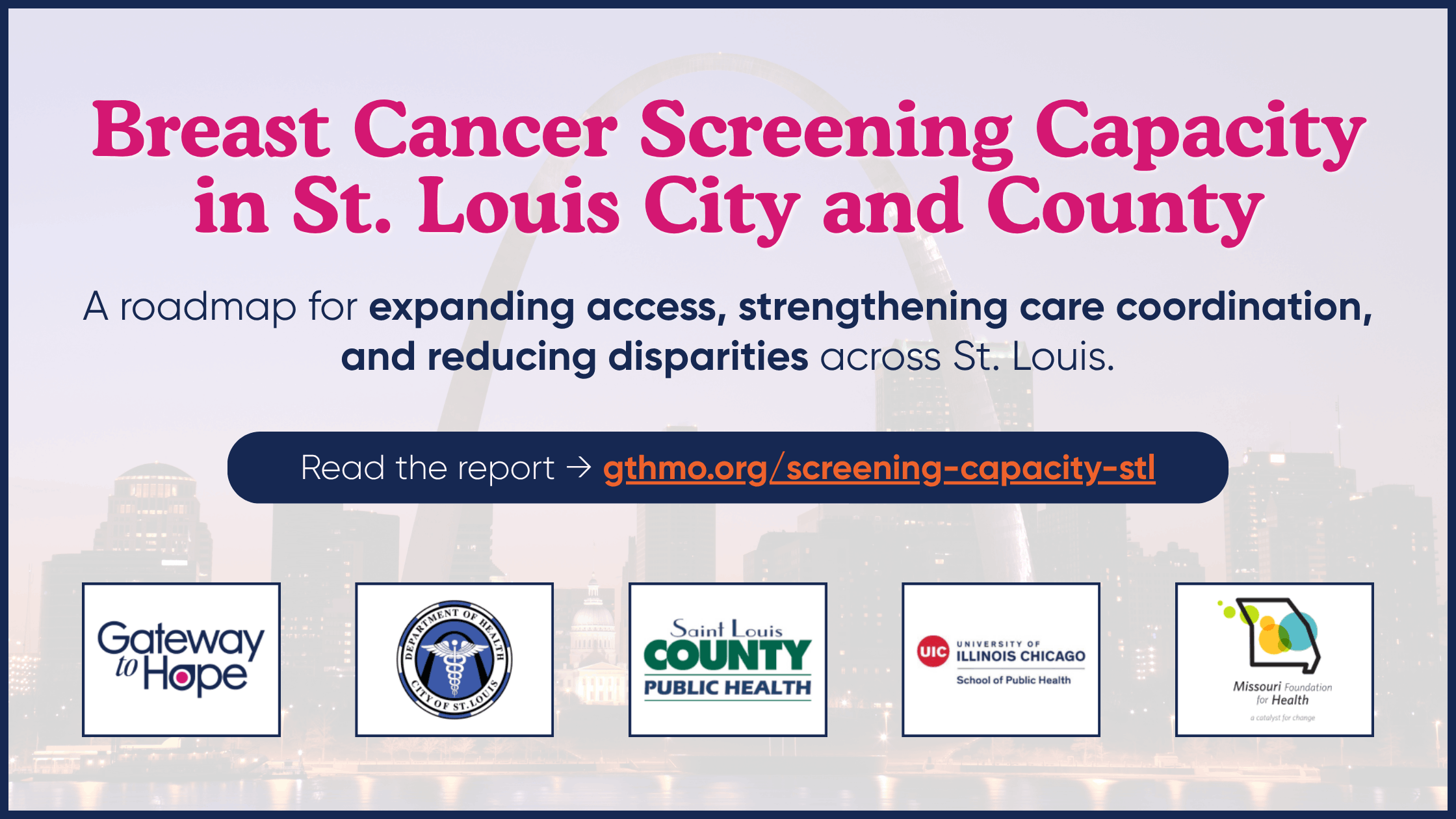
Gateway to Hope, in partnership with the City of St. Louis Department of Health, the Saint Louis County Department of Public Health, the University of Illinois Chicago School of Public Health, and the Missouri Foundation for Health, today released research showing the St. Louis region’s capacity to deliver life-saving breast healthcare.
This first-of-its-kind study represents one of the most thorough regional analyses of breast cancer disparities conducted in the U.S., drawing on cancer registry data, provider surveys and claims data, and combining population-level epidemiological data with a regional survey of mammography providers. Over 90% of local providers participated.
Titled “Breast Cancer Screening Capacity in St. Louis City and County,” the study found that, due to various factors including talent shortages and access barriers, the St. Louis region uses just half of its available mammography capacity, and screening rates fall far below recommended levels. Average capacity utilization is 56%, with some facilities operating as low as 8% to 12%. Safety-net providers are the most underused. In 2024, just half of eligible women in St. Louis City and County underwent a mammogram.
“The data in this report is groundbreaking, and we can all heed the calls to action stemming from it,” said Katie Manga, CEO, Gateway to Hope. “We know that breast cancer has a 90+% cure rate when detected soon enough. The St. Louis region can do more to ensure all women have access to life-saving early detection care.”
The study is the result of a multi-year, cross-sector collaboration with local healthcare systems, led by Gateway to Hope’s Research and Impact team and co-authored by the City of St. Louis Department of Health, the Saint Louis County Department of Public Health, and the University of Illinois Chicago School of Public Health. The report was funded by the Missouri Foundation for Health.
“Our region has the infrastructure and the expertise. What we need now is an even greater will to align those resources strategically so all women, not just some, have access,” said Manga. We know what it takes to close the divides, and this landmark analysis gives our region a roadmap for action. Gateway to Hope stands alongside our area’s healthcare leaders to help address disparities in care and save more lives.”
Find the full analysis, “Breast Cancer Screening Capacity in St. Louis City and County,” as well as a summary of key findings, at https://gthmo.org/screening-capacity-stl.