INSIGHTS
Research & Advocacy
Better understanding patient needs.
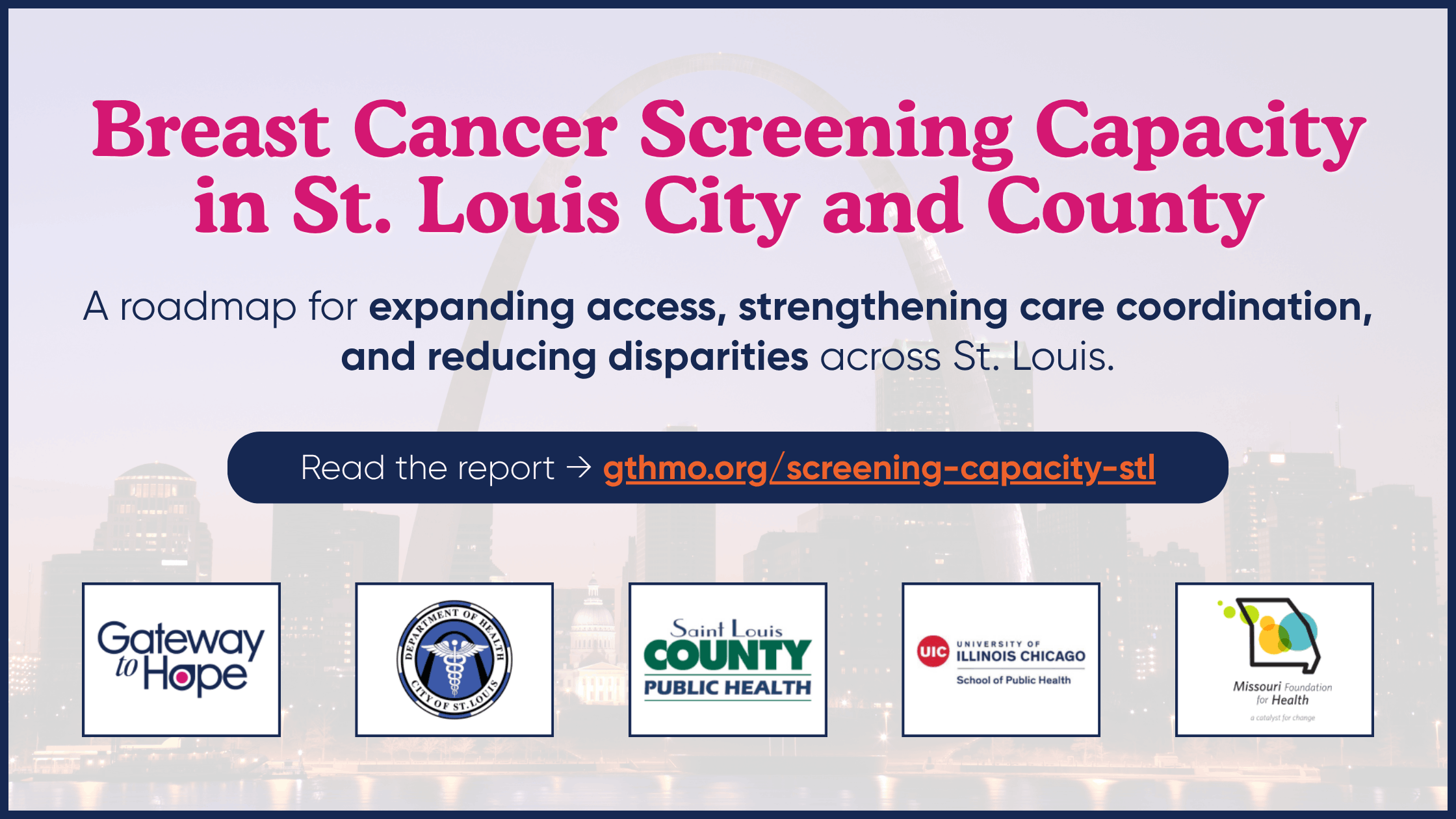
Breast Cancer and Screening Capacity in St. Louis City & County
The report, published on July 20, 2026, is a data collaborative with research produced through a partnership with local public health departments, area health care organizations, and vested stakeholders. It represents one of the most thorough regional analyses of breast cancer disparities ever conducted in the St. Louis area, drawing on cancer registry data, provider surveys, and claims data.
Read More
Gateway to Hope invests in community-based research and advocacy so we can better understand gaps in care and patient needs. Our team compiles careful analysis of the resources and care available in our communities, documents the barriers patients face, and gathers patient data and their feedback on experiences in our program.
We have the data to demonstrate that our approach really works.
Data helps us make informed decisions about effective program growth, and guides our work advocating for systemic improvements.
We are working toward a future where safety net programs and care delivery models are operating efficiently and are achieving population-level improvements in health outcomes.
Our Key Projects
Mammography Quality Research Study — Missouri Foundation for Health
- With the support of the Missouri Foundation for Health, we are partnering with healthcare systems and public health agencies across our region to complete a baseline study of breast cancer disparities in St. Louis region.
- We are working to understand, collectively, the gaps in care in our region and how we can partner to fill those patient needs.
- Ultimately, this research can be replicated across the entire state of Missouri.
Pilot project with Washington University in St. Louis School of Medicine
- We are partnering on a clinical project, Cervical Cancer Community Program (C3P), to apply GTH’s proven navigation and support model to serve the needs of women needing cervical health screenings and cervical cancer treatment.
- Careful study of the results will give us insights into how doctors and community organizations can partner to improve women’s health outcomes.
The Latest in Research & Learning
Announcing a Landmark Analysis of Breast Cancer Screening Capacity in St. Louis
Gateway to Hope, in partnership with the City of St. Louis Department of Health, the Saint Louis County Department of Public Health, the University of Illinois Chicago School of Public Health, and...
Collaborating to Improve Metastatic Breast Cancer Care
Gateway to Hope is proud to partner with the University of Kansas Medical Center (KUMC) and the University of Kansas Cancer Center (KUCC) on an exciting initiative aimed at strengthening support for...
Questions?
Contact:
Joann Lee, MPH
Research & Learning Manager
jlee@gthmo.org